
Northern Lights Forecast Murmansk: Live Aurora Chance Today
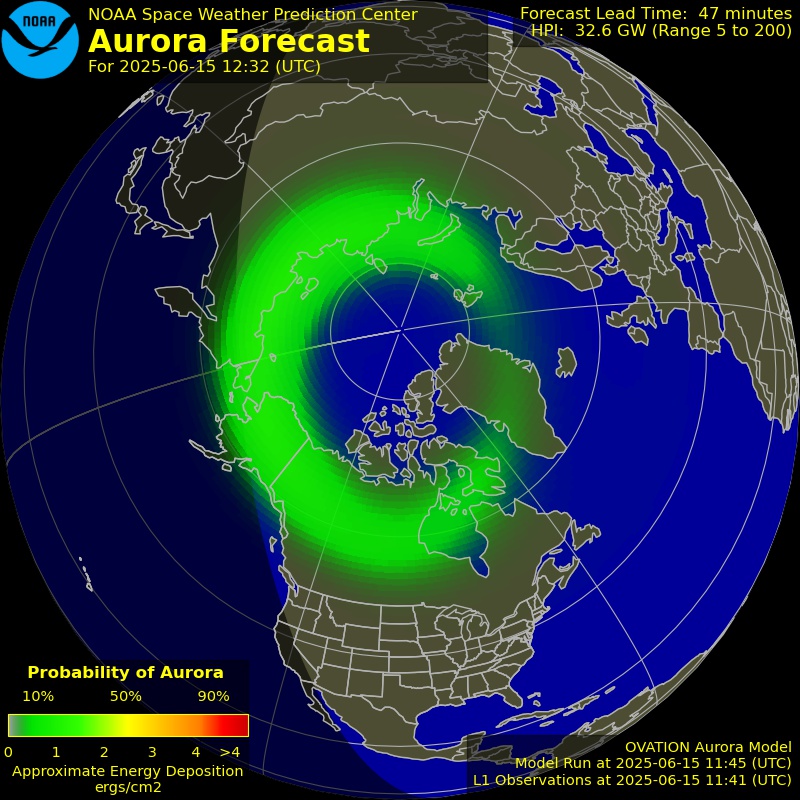
Current global aurora oval
Live view of the auroral oval over the Northern Hemisphere, from NOAA's OVATION model. Updated every few minutes.
Kp index: observed and 3-day forecast
Global geomagnetic activity. For Murmansk, Kp 2–3 is usually already enough. Hover over the chart for exact values; the dashed line marks the current moment.
Kp index: 27-day outlook
NOAA's longer-range outlook of the largest expected daily Kp value. This is NOAA's standard extended forecast (27 days, tied to the Sun's rotation period); NOAA does not issue a 30-day Kp product.
Bz component of the interplanetary magnetic field (last 3 h)
Negative (southward) Bz opens Earth's magnetosphere, so aurora becomes much more likely.
Bt — total interplanetary magnetic field strength (last 3 h)
The overall strength of the magnetic field, regardless of direction. A strong Bt with a southward Bz is the most favourable combination.
Solar wind speed (last 3 h)
Above 500 km/s is considered fast.
Proton density (last 3 h)
Denser solar wind gives a stronger push on the magnetosphere.
Hemispheric power (auroral energy input)
Total electron/ion energy deposited in the polar atmosphere, in gigawatts, separately for each hemisphere. Higher values mean a brighter, more active aurora. Northern-hemisphere power is what matters for Murmansk.
Dst index — global magnetic storm strength (last 6 h)
Dst measures how much Earth's magnetic field is disturbed, in nanotesla. Values below −50 nT indicate a geomagnetic storm — these are usually the best nights for aurora.
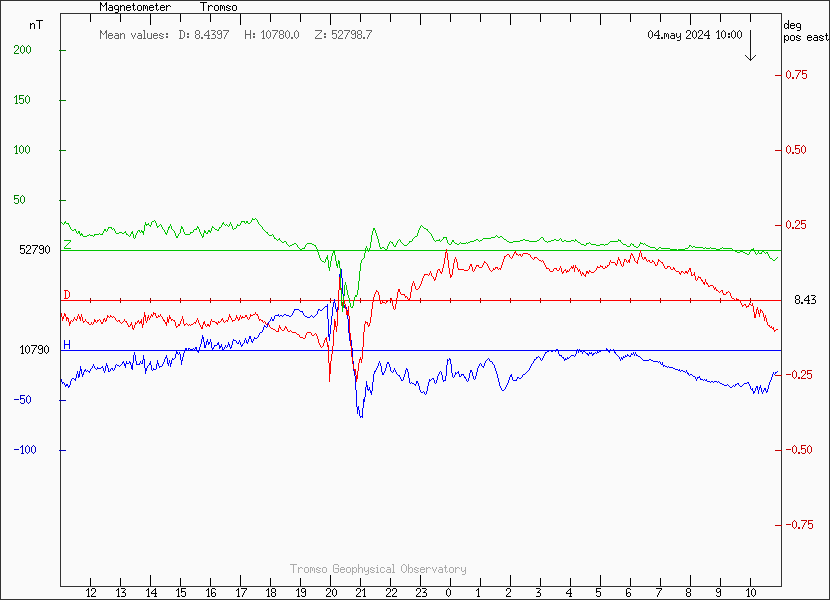
Tromsø magnetometer (D, H, Z)
Live ground-based magnetometer from the Tromsø Geophysical Observatory (Norway), about 300 km from Murmansk. Sharp wiggles in the blue (H) and green (Z) traces mark real geomagnetic disturbances happening right now at auroral latitudes — a strong, fast-moving classic sign of active aurora overhead.
Live aurora cameras, Scandinavia
Real sky cameras from the aurora belt. If you can't get outside right now, these show what's actually happening overhead at each site.


